
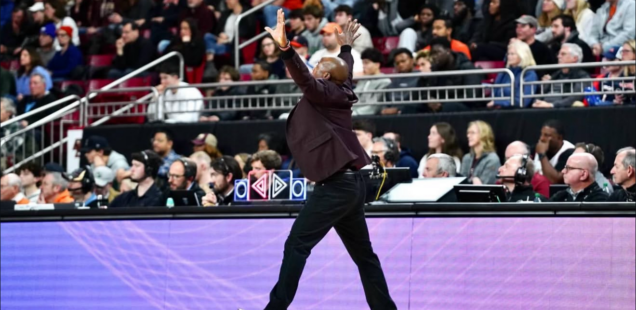
Too close too often: Eagles’ struggle to finish games has defined their season
By NICK PETRALIA
Boston College’s Jan. 31 loss to Virginia marked the ninth time this season the Eagles lost a game in which they led in the second half. The Eagles (9-12, 2-6 ACC) held an advantage against the Cavaliers, including a five-point halftime lead, until Malik Thomas’ layup tied the game with 16:15 remaining. From there, BC was unable to pull even despite multiple opportunities and ultimately lost 73-66.
Losing close games and blowing leads has been a theme for the Eagles this season. In all but one loss, BC held a lead at some point in the second half. In seven of those games, the Eagles held the lead in the final 10 minutes. Digging deeper, BC led in the final five minutes in five of those contests. Additionally, the Eagles led in the final minute of losses to Florida Atlantic and Central Connecticut State, including blowing a five-point lead to FAU in the final 60 seconds. These figures do not include losses to NC State and Davidson, games in which BC was within three points in the final 10 minutes.
Of course, the Eagles’ play style is conducive to these kinds of implosions. Earl Grant’s squad is 348th in the country and second-to-last in the ACC in free-throw percentage at 65.8%. In the second half and overtime of BC’s losses this season, that figure drops to 62.4%, and in the Eagles’ last six losses it has fallen to 57.8%. Those missed foul shots have allowed opponents to rally and shown teams that fouling BC, rather than playing straight-up defense, can be advantageous.
While free throws have been among the most prevalent issues this season, BC’s offensive struggles overall have allowed teams to remain competitive even when they play poorly. The Eagles rank last in the ACC in both scoring and field-goal percentage. Virginia, which ranks in the top five in the ACC in 3-point percentage, went 2 of 16 from beyond the arc and scored 27 points in the first half against BC. The Eagles shot 50% from the field and 3 of 7 from 3-point range, yet only led 32-27 at halftime. While Grant and company rank among the ACC’s better defensive teams, third in both opponents’ points per game and 3-point percentage, their lack of consistent offense has prevented them from becoming a middle-of-the-pack team.
From a more optimistic perspective, BC either led or was within three points in the second half of all but one loss this season (Clemson). Despite owning one of the worst records in the conference, the Eagles have “matched up well” and “hung in there.” Another way to frame it is that they play up or down to their competition. Either way, if the goal is to play competitive games throughout the season, BC has accomplished that.
The closeness of those games, however, is what fuels the frustration among students and fans. The 9-12 Eagles were a handful of key plays away from being 14-7 or better. Instead, they sit at the bottom of the conference.
Opinion
If I were BC’s coach, here are the changes I would make moving forward:
- Stop shooting so many 3s. The Eagles are one of the worst 3-point shooting teams in the nation.
- Increase the tempo and push the ball. BC ranks 250th nationally in possessions per game. It does not bode well for a poor shooting team to also play at a slow pace. This is not a call to implement Mike D’Antoni’s seven-seconds-or-less offense, but BC’s half-court sets take too long to develop. With athletes like Aidan Shaw and Jayden Hastings, the Eagles should run in transition, attack the rim and throw lobs.
- Press. The roster features strong defenders such as Fred Payne and Chase Forte, along with athleticism throughout the lineup. BC should apply more backcourt pressure to force turnovers and generate extra possessions.
There is still time for the Eagles to salvage the season, including a potential ACC tournament run. If nothing changes soon, however, another last-place finish under Grant appears likely.