
BC Football: Offensive Roster Preview
By Luke Ballard & Grady Daniels
The Eagles’ offense last season was jarring to say the least following what was a promising 2024 campaign, as the Eagles finished 101st in points per game (21.7) and 120th in second-half points (8.6). They did finish 78th in total offense, although this and the points per game do include two clear outliers in the Michigan State and Fordham games to start the season. The Eagles were 120th in the nation in rushing yards per game (104.5), 122nd in sacks (3.1), gave away the ball nearly 2 times per game, and were 101st in the nation in third-down conversions per game (4.7). Despite all this, one of the most concerning notes as the season progressed was the shift away from the run-heavy offense that had brought the Eagles success in 2024, with guys like Kye Robichaux. The Eagles’ change from running to passing play percentage was 15% from 2024 to 2025, going from 57% run plays to 42%, the most among power conference teams and 4th overall in the nation. At times, the run game could not get off the ground in the early stages of a game, and by the second half the Eagles faced too large a deficit to lean on again, forced to use more of an air raid style. Will Lawing is out as offensive coordinator, replaced by Bill O’Brien, who will call all the shots on offense this year. This appears to be an area that BC recognized had to be better: bringing in Evan Dickens and Nolan Ray while making significant additions to the offensive line.
Another offensive story last year was the “QB carousel” as initial starter Dylan Lonergan would be switched out for vet Grayson James and back again, which seemed unfair to both players: Lonergan for his development and James for his servitude towards the program, and freshman Shaker Reisig would even appear before his transfer off the Heights. Now, all 3 are gone, and in are Mason McKenzie, Grayson Wilson, and Femi Babalola. McKenzie, with all likelihood, will start after transferring up from the Division II level, and brings a speed element we didn’t see at the position in the Eagles’ offense last year. We break them down in more detail below.
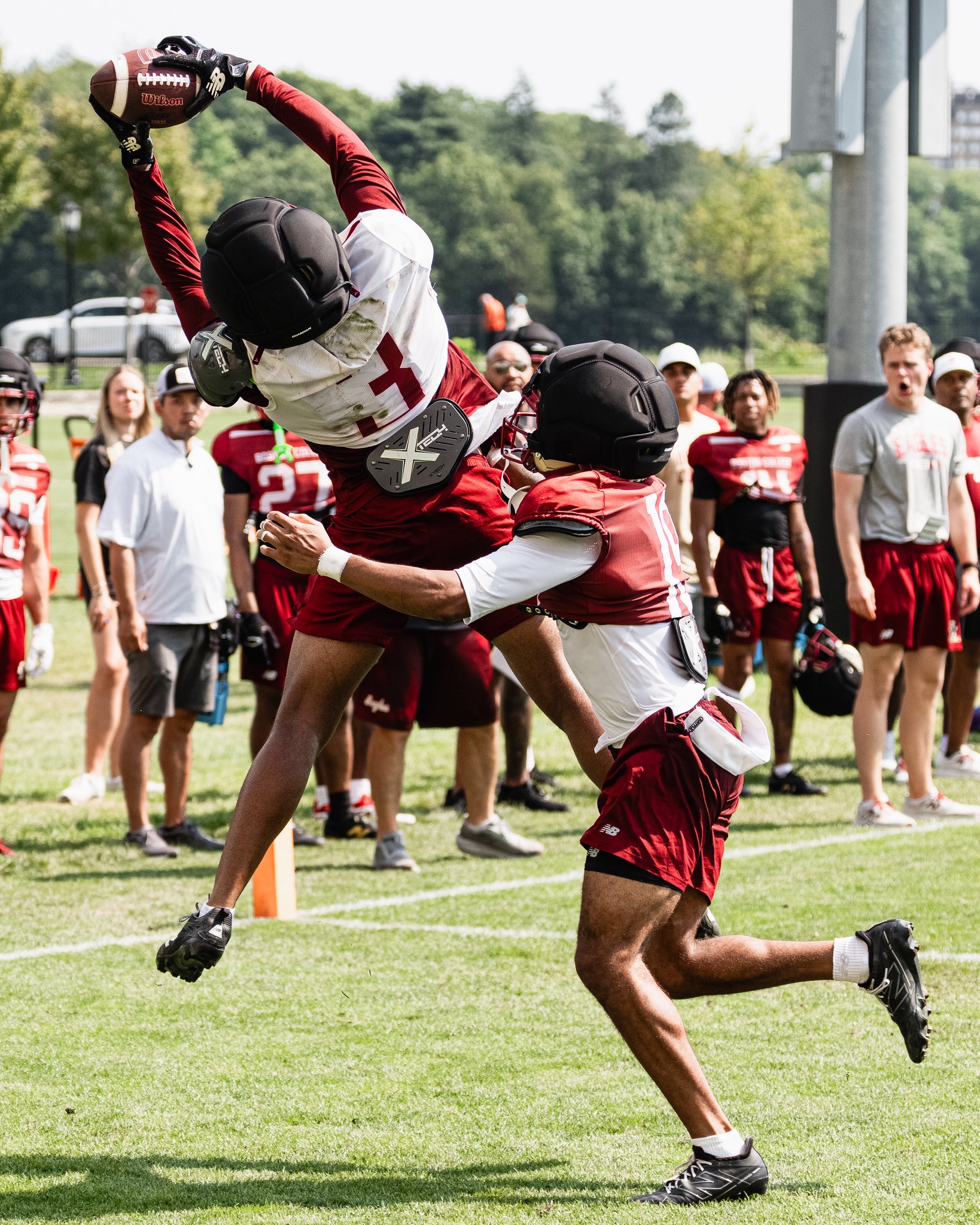
Significant departures to the wide receiver room and the injury to Kaelan Chudzinski mean new targets for the Eagles’ gunslingers: Lewis Bond, Jeremiah Franklin, and Reed Harris are all gone, so there is lots of opportunity for returners like Jaedn Skeete, Dawson Pough, VJ Wilkins, and Zeke Moore to see expanded roles, and fresh starts for a few transfers such as Colgate’s Reed Swanson and UNC’s Javarius Green.
Big adjustments have been made to the Eagles’ offense across the board – and we’ll see how it’ll play out in just a few weeks.
Per BCFootball on X
QUARTERBACKS
Seemingly the make-or-break position group for the Eagles yet again will be the quarterback group as BC is primed to start its season with a different gunslinger for the fourth year in a row. After the disappointing showing from the position group in 2025, all eyes are on head coach Bill O’Brien and quarterback position coach Johnathan DiBiaso as the Eagles hope to find their solidified number one. Although clouded by ambiguity in the early summer, O’Brien has made a clear choice for who his QB1 will be going into Week 1 vs. Cincinnati.
Coming into BC listed at 6 ‘1”, 200lbs., junior transfer Mason McKenzie enters the limelight for the Eagles as the next number one under Bill O’Brien. Before his time at Boston College, McKenzie threw for 4,301 yards with 31 touchdowns and 17 interceptions through 3 seasons at NCAA DII Saginaw Valley State in Michigan. McKenzie also added 1,673 rushing yards and 18 rushing touchdowns in his time at Saginaw Valley. In his time at Saginaw Valley, McKenzie was awarded the GLIAC Conference Rookie of the Year in 2024 and the GLIAC Conference Player of the Year in 2025. After redshirting his freshman year and playing only three games, McKenzie enters as a junior with hopes to become BC’s next solidified starter.
McKenzie’s three-dimensional playstyle is similar to that of Thomas Castellanos, BC’s quarterback from the 2023 and 2024 seasons. Being able to evade pressure and move out of the pocket, McKenzie will be sure to keep defenses on their toes as he has proved to be a viable passing and rushing threat. How McKenzie will adjust to Power 4 play is uncertain, but he certainly has the raw skill set and tools to be BC’s next number one. Questions have arisen concerning McKenzie’s accuracy and arm strength, but tape from summer and fall camps seems to suggest that it has been a major focus for McKenzie and staff as they approach Cincinnati on September 5.
In what is sure to be a gamble, it seems that O’Brien believes he can develop the DII star into an ACC-caliber player. Following the blueprint from Lane Kiffin’s Trinidad Chambliss experiment, it is clear that O’Brien sees a large upside in McKenzie’s raw talent he displayed in GLIAC play. Many critics have fairly pointed out that the jump from NCAA DII to Power 4 football may be a bit ambitious for the redshirt junior. However, it is important to note that O’Brien’s track record of developing quarterbacks is one of the best in the nation among active coaches. Among the list are players such as Tom Brady, who won the 2010 NFL MVP under O’Brien, and Bryce Young, who won the 2021 Heisman Trophy under O’Brien as well. However, the most important player on this list is Matt McGloin, a former Penn State walk-on turned NFL quarterback under the vision of O’Brien. If O’Brien can muster up some of the same magic that he had at Penn State, perhaps McKenzie can be the missing piece of the puzzle for O’Brien in year three.
Backing up McKenzie is former ESPN four-star recruit and Arkansas Razorback transfer Grayson Wilson. The redshirt freshman did not appear in any games for Arkansas last year, and will certainly use this year to develop and grow under BC’s talented staff. The upside with Wilson is strong, as scouting reports have him touted with “NFL arm strength.” With a year to learn under O’Brien and DiBiaso, Wilson can set himself up well to be BC’s starting quarterback when the Mason McKenzie era concludes.
RUNNING BACKS
The running back group, and the line in front of it, may be the most important to the Eagles’ success this year. Last year, they totaled 104 yards per game, ranking 127th in the nation, and often struggled to gain momentum early. Bill O’Brien made it a priority to bolster the group in the offseason following the departure of Turbo Richard (Indiana), as well as the graduation of both Jordan McDonald and Alex Broome, adding Evan Dickens (Liberty) and Nolan Ray (Maryland). Dickens will likely feature as the star back, coming off a season totaling 1,339 rushing yards with the Flames, notably with a heavy workload across 11 games last season. At 5 ’11, 195 lbs, Dickens is a balanced addition to the Eagles’ offense who has both the speed to get into the open field and break through contact. Throughout spring practices, Dickens was someone who stood out in an offense that at times was thoroughly outplayed by Ted Roof’s defense. Nolan Ray comes to the Heights after spending 3 years with Maryland, finishing last season with 289 yards on the ground. Ray took a step back from his freshman campaign and saw a reduced role following the Terrapins loss to Nebraska in October. Ray’s 6’0, 210-pound frame will likely solidify him within the run game rotation in short-yardage situations and as an off-tempo back. We saw this sparingly last year with Jordan McDonald, to a fair amount of success in BC’s otherwise lacking run game, who had a similar physical profile with a real ability to fight through contact at the line of scrimmage. The other recent comparison that could be drawn is to Kye Robichaux, although Ray’s role will likely fall closer to McDonald’s, as a short-yardage or 3rd down back who can exploit tired defenses, rather than being the one to tire them out. Ray could greatly benefit from having another running back like Dickens to reap the benefits from.
Returning to BC for his second season is Bo MacCormack III, as is Mekhi Dodd. Both backs had impressive showings in the spring and will look to have expanded roles in the upcoming year. MacCormack would total 43 yards on 15 rush attempts last season, and saw more exposure in special teams on kick returns. It should be noted that he has impressed in preseason both years so far with the team, and is a real workhorse. He finished as Massachusetts’ all-time leading rusher after his time at BB & N, and at 5 ’10, 200lbs, lays down a good block and has the speed to break away as well as break a tackle, but most notably has a strong ability to read the game. Despite the physical tools that could carry him at the high school level in Massachusetts, MacCormack stood out as a patient running back who was so dominant largely in part to his vision in the backfield. MacCormack seems primed to be the 2nd or 3rd back in the room, along with Ray. Dodd made two appearances last season, keeping a year of eligibility, after featuring briefly against Georgia Tech and in the season finale against Syracuse. Dodd is a strong back who can fight through contact, but there remains an interesting prospect for him in the passing game. He picked up a reception against Syracuse last year, and this would likely be the niche he could fill in this rather full running back room, and he has shown good awareness both blocking and getting into the flats even in his limited time. Both should be valuable additions to complement the games of both transfers.
Finally, among the new freshmen, Sedric Addison is one to watch. The Georgia native excelled at the high school level and barely missed a beat transitioning to spring ball in the Northeast. What stands out most about the freshman is the speed he has at 5 ’11, 205lbs, to change plays completely and get downhill, having a unique blend of both size and speed to create breakaway plays from seemingly dead positions. He has a background in track in high school, competing at the state level, which complements his power nicely. Completing the running back group this year are Billy Barrett (Fr), Tim Longo (RsFr), and Anthony Ferucci (RsJr).
WIDE RECEIVERS & TIGHT ENDS
The Eagles are rolling out a new-look receiver room, and the tight end position will be very different thanks to Jeremiah Franklin’s departure and the injury to Kaelan Chudzinski prior to the season’s start.
At wide receiver, Jaedn Skeete highlights the returners, joined by Dawson Pough, VJ Wilkins, Nedrick Boldin Jr and Dawson Pough. Transfers include Jackson Wade, Reed Swanson, Javarius Green, and Landon Wright. If there is one thing to note with the group – it is that snaps will be up for grabs likely as the season progresses, with Jaedn Skeete leading the group as things stand, however, the Eagles receiver is coming off of using his redshirt following a shoulder injury, only appearing in 4 games last year, grabbing a touchdown in the first two games against Fordham and Michigan State, and returning to face Notre Dame; gaining 73 yards on 8 catches against the formidable Irish squad. Pough and Wilkins should both be solid contributors to the Eagles’ receiver room: Pough is entering his sophomore season on the Heights, and has shown his ability as a deep threat in his first year with the Eagles, tallying 197 yards on 13 catches last season, working well with both Lonergan and James – a good sign for a BC side that will have a new man under center. Meanwhile, VJ Wilkins returns after a late-season injury and will enter his redshirt Senior season. The former Campbell receiver would pick up 113 yards on 4 receptions and has shown real promise in preseason and spring practices with his ability to gain separation and will have an expanded role this year. A sneakier pick for a breakout is Johnathan Montague Jr, who missed last season due to injury. The former quarterback has a good football mind and has impressed with his route running in his return to the field. Finally, Nedrick Boldin Jr. will look to make his first appearance in a Boston College jersey this season after showing well through camp.
With the platoon of transfers, a standout has been Reed Swanson. Swanson arrived after spending 3 years with Colgate, and was named to the Patriot League Second Team in 2025 after totaling 939 yards and 8 touchdowns. Swanson will be an integral part of the Eagles’ passing attack, as his 6 ‘6 frame and ability in the air make him a red-zone threat that defenses have to pay attention to. Especially with the depleted tight end position, Swanson’s ability to be a big target for McKenzie and/or Wilson is notable, and could be a go-to when needing to get out of a pinch or working down the sidelines. Also joining the Eagles is Javarius Green, and the North Carolina transfer will be wearing Zay Flowers’ #4 for the upcoming season. Like Flowers, Green is a speedy, smaller receiver who I would expect to see a lot more work in the shorter areas of the field; however, at 205 lbs, he also has the ability to break a tackle and add on some yards after the catch. Finally, Landon Wright joins from Washington State, and he is someone who would likely be best employed as a serious threat or as a slot receiver: Wright checks in at 6 ‘0, 180 lbs, but after watching him, you’ll notice his really quick burst and electric speed. Out of the 3 transfers, Wright is someone who I would look to really take a leap in terms of production and workload. Jackson Wade transfers from Florida, where he was a preferred walk-on. Rounding out the wide receiver position are Will Graves III, Michael Landolfi, Duke Brennan, Zach Schnorrbusch, and Bryce Dopson.
With the tight end position, the loss of both Franklin and Chudzinski is devastating to the offense, to say the least, and will likely mandate a slightly altered offensive philosophy. The Eagles return two tight ends with experience: Brady Clough and Zeke Moore, who differ greatly in their styles of play. Clough stands at 6’3, 240, and is the better pass catcher, but will likely serve as a big target over the middle for the Eagles, unlikely to see a huge share of the targets in the passing game; while Moore, who played in all 12 games last year, stands at 6’1, 245, and is an outstanding blocker, but lacks in the receiving game. Redshirt sophomore Danny Edgehille will benefit from the additional snaps, but would be expected to be lower in the depth chart, as would Bryce Lewis – who switches from linebacker, but has really impressed and adapted to the system on the opposite side of the football quickly. Finally, the position is rounded out with Florida transfer Cameron Kossman and returners DJ Johnson and Dominic Desarno.
OFFENSIVE LINE
The offensive line will have a very new look this year after losing several key pieces: Jude Bowry and Logan Taylor to the NFL Draft (#OLineU), and Kevin Cline and Eryx Daugherty no longer being with the program. The line will be led by a new coach as well, as Kurt Anderson joins from UMass.
Versatile Michael Crounse is the lone starter to return, and he’ll slot in at center this season after starting 9 games at the position last year. The redshirt junior is working with an all-new group this year and stands in at 6’4, 315 lbs, anchoring the inside of the Eagles’ offensive line in 2026. Kristian Phillips will also likely start on the interior for BOB’s offense. The Michigan State transfer has been oft-injured in his time at the collegiate level, but has played well when healthy. It will likely be integral to the Eagles’ O-line for Phillips to be available. Robert Smith has looked good in his appearances in practice, and looked promising as a true freshman in 5 games with BC last year. While Smith and transfer Redshirt Senior Owen Snively will likely battle for snaps, these 4 (if healthy) should be the main interior linemen. Also notable for backups will be Judah Pruitt, Jani Norwood (UNC Transfer), and DJ Williams.
Moving to the outside line, one of the most interesting names is Veguer Jean-Jumeau, who transfers to BC from Tennessee State. The tackle towers over his fellow linemen and opponents at 6’9, 305, and only allowed 2 sacks in his time with the Tigers. Jean-Jumeau didn’t look any more out of his depth than any of the other linemen through spring practices, and I think there is a real play to be made developing the sought-after lineman. However, with Mason McKenzie under center, there may be mobility concerns with McKenzie’s legs, despite Jean-Jumeau’s impressive speed for his size. Pape Abdoulaye Sy could be one of the starters after serving as NFL 4th-round pick Jude Bowry’s backup and making a few brief appearances on offense last season. Transferring in are Trevon Humphrey and Reggie Jackson. Both bring a level of experience to an otherwise very young Eagles tackle group, and it would not be the least bit surprising to see both starting the first drive of the season in Cincinnati. Jackson is particularly intriguing, and has appeared to be very solid in run blocking, which as noted earlier will likely be much more emphasized in the upcoming season. Humphrey joins the Heights from NC Central, where he has his fair share of playing time after tallying 36 starts. Soulaye Diawara has a similar frame as Jean-Jumeau, although not as mobile; he has already spent time with the Eagles. Amir Johnson has another year under his belt with the Eagles, and rounding out the position for the Eagles is Tanner Chlupsa.
The offensive line play will be one of the most interesting things to watch in the first few games, as there are a lot of snaps to play for both on the interior and especially with the tackles, as all new faces join forces. With the style changing under Mason McKenzie, the offensive line play will have to be better for the Eagles to produce on that side of the football, and while it may take some mixing-and-matching in order to discover the right group, there is enough talent at the position to believe O’Brien can find it.