
Breakdown: What went wrong with the run defense vs. Notre Dame
By Bradley Smart
The Boston College football team frequently loaded the line of scrimmage throughout last Saturday’s matchup with Notre Dame, almost daring the Irish to try and beat them with the run.
Notre Dame’s passing offense has had its well-documented struggles, with junior quarterback Brandon Wimbush coming off of a 20-for-40 passing game against Georgia. Anybody watching film from that game, a 20-19 loss to the Bulldogs, would’ve seen an inconsistent passer who struggled against a quality pass rush. So, it seemed logical to load the box and put pressure both on Wimbush and plug up holes to keep talented running back Josh Adams contained.
The problem, however, was the secondary struggled to provide the typical last line of defense. After the Irish won the line of scrimmage, the second level was full of space. A few missed tackles within the first 10 yards allowed Adams and Wimbush to find plenty of room to run. Both cleared 200 rushing yards on the day as the team averaged 10.1 per attempt.
Eagles coach Steve Addazio commented after the game that the box score didn’t reflect an awful defense, saying, “On seven plays we had a breakdown of someone not being in the right gap, or someone didn’t tackle well. So a 12-yard gain became a 60-yard gain. That happened 7 times. There’s a difference between that and getting chewed up because you can’t stop anybody. When you’re getting blocked, guys are just getting overtaken. That didn’t happen in that game.”
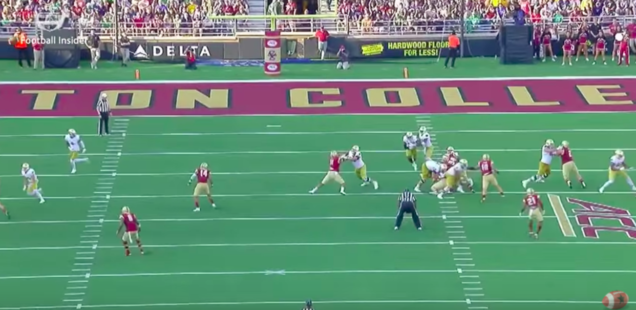
He has a point, but a certain amount of props needs to go to the Irish front line, who created huge gaps to run through. This is a line that features NFL draft prospects in left tackle Mike McGlinchey and left guard Quenton Nelson. It’s easy to see on the film, like on this run from Adams in the second quarter to the BC 25-yard line.
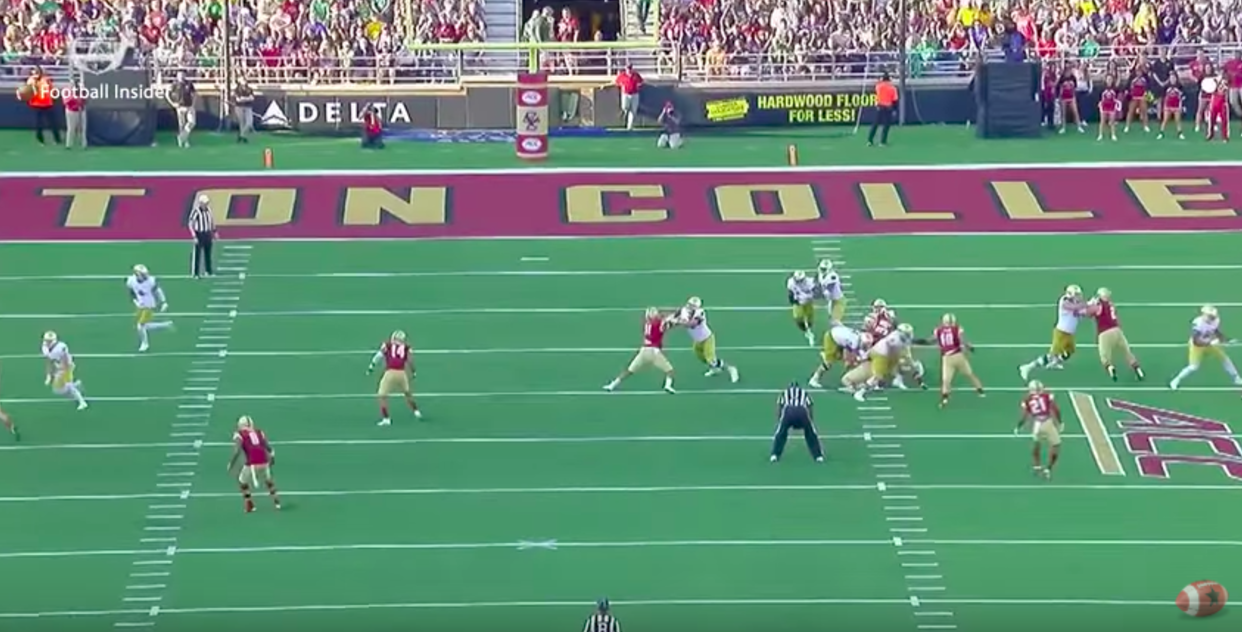
That’s a huge hole, and Adams is able to just sprint up the middle for a big gain. That was an instance where the Eagles were rushing five and he was quickly able to get into the secondary.
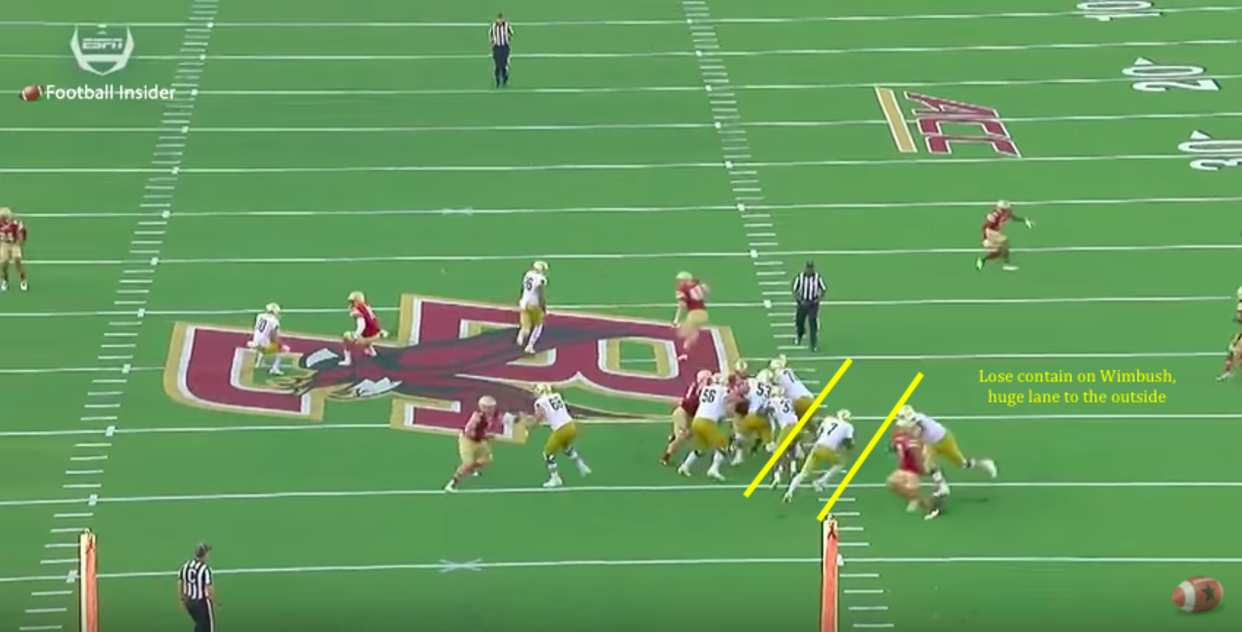
Some of the other longer runs came as a result of bad angles, like Wimbush’s run to the BC 10-yard line in the third quarter. After the pocket begins to collapse and the Eagles secondary is defending well, Wimbush breaks to the outside. Cornerback Isaac Yiadom is one-on-one with him in space, but gives up the sideline after he bites on a strong cut and just like that, Wimbush is free down the sideline.
On that play, Eagles star defensive lineman Harold Landry was rushing on the side, but Irish right guard Tommy Kraemer ran with him. The rest of the line pushed Boston College back inside, freeing up a huge gap for Wimbush to run through.
Finally, one last long run to breakdown. This run from Adams in the third quarter is an example of excellent line play, clearly showing how the Irish were able to continually get their runners into the second level and pile up yardage. Addazio said it was an issue of not being in the right gap, but shots like these seems to show pure dominance.
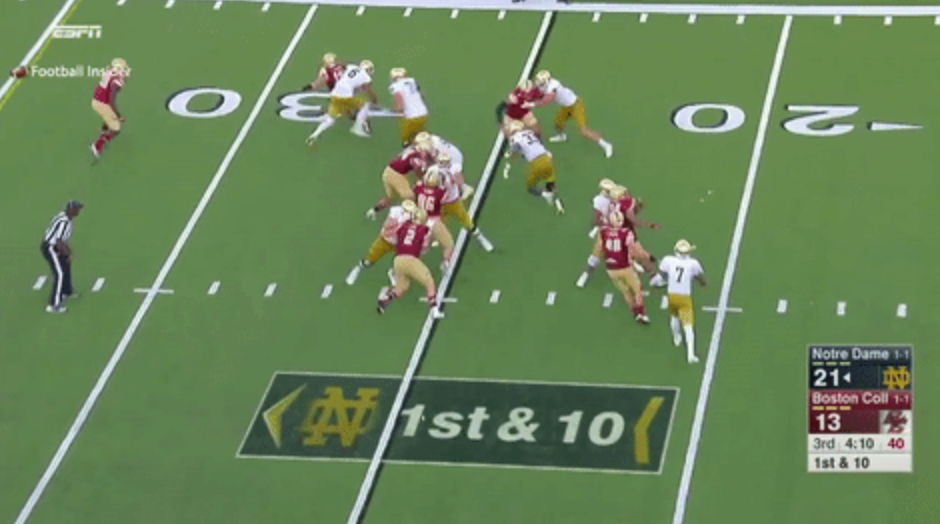
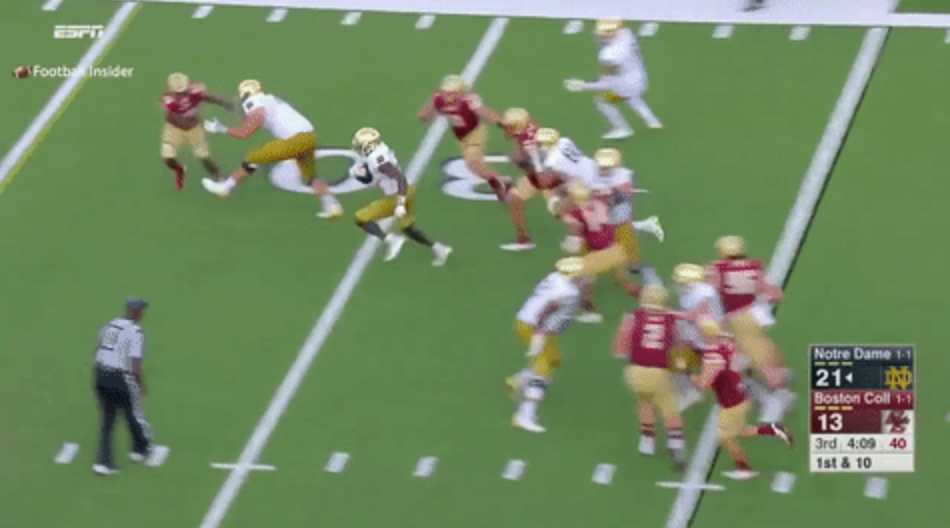
The Irish line pulls, and Adams is just following a lead blocker into wide open space. He’s untouched until a diving member of the Eagles secondary gets a hand on his foot, but that’s it until 20 or so yards downfield.
Granted, this article seems to be just a long summary of the big gains Notre Dame was able to get, but it speaks to a bigger issue. The defense has been a strength in recent years for Boston College, and it’s been a big reason they’ve been able to stay in games with a weaker offense.
Last season, the Eagles went 7-6 behind the 24th ranked defense in the country (by S&P+). The offense was a horrendous 124th, but excellent play on the other side of the ball was crucial in playing above .500. They ranked second in havoc rate, which is a measure of the percentage of times a defense either records a tackle for loss, defends a pass, or forces a fumble.
The year before, the 3-9 Eagles ranked fourth in defense. The offense managed just 17 points a game, however, so holding teams like Notre Dame or Louisville to under 20 points wasn’t enough.
This season, the Eagles secondary has played well, ranking 33rd in passing success rate. The rushing defense, though, currently ranks 85th. Paired with an offense that doesn’t rank above 100 in any of Bill Connolly’s (SB Nation’s Football Study Hall) five success factors, Boston College is in some trouble.
Unfortunately, this week’s matchup with No. 2 Clemson doesn’t offer much of a breather. The Tigers feature a dual-threat quarterback in Kelly Bryant, much to the chagrin of an Eagles defense that couldn’t contain Wimbush. Bryant is a 6-4, 220-pound junior who averages almost seven yards a run. He leads the team with five rushing touchdowns.
Clemson also boasts two NFL draft prospects on their offensive line, in guard Tyrone Crowder and tackle Mitch Hyatt. They create plenty of space for running backs Tavien Feaster (176 yards, 9.3 ypc, TD), Travis Etienne (179 yards, 12.8 ypc, 2 TDs) and C.J. Fuller (94 yards, 4.5 ypc, 2 TDs).
Last year, with current Texans starting quarterback Deshaun Watson at the helm, the Tigers rolled to a 56-10 win at Alumni Stadium. Kickoff this Saturday comes at 3:30 p.m. in Death Valley.